
Resilience, Access, and Habitat Restoration Project
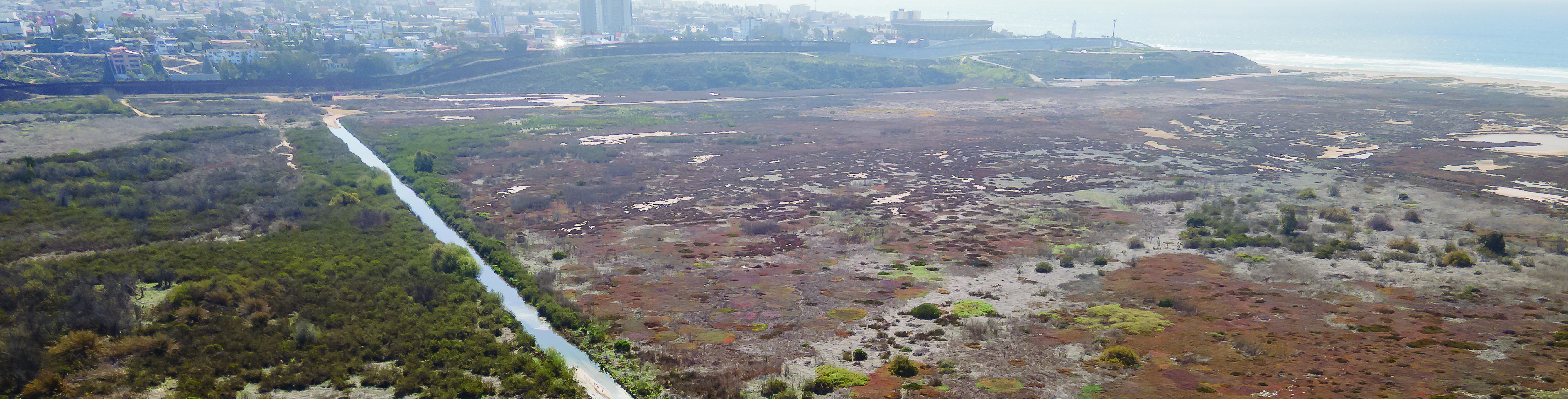
Border Field State Park - RAHR Project
Resilience, Access, and Habitat Restoration Project
See the Border Field State Park webpage for more Park information
California State Parks proposes to remove, upgrade and relocate portions of Monument Road at Border Field State Park to improve the health and function of the Tijuana Estuary watershed; maximize the resilience of Monument Road from the effects of future sea level rise; and address seasonal flooding of the existing roadway to improve coastal public access to the park. Flooding prevents public access to the park and Monument Mesa, which is caused by storm runoff flows primarily from the nearby drainages of Goat Canyon and Yogurt Canyon that convey flows from Tijuana, Mexico, northerly into the United States. These flows result in continual flooding of both the north-south and east-west portions of the existing roadway.
The project proposes to improve the health and function of the watershed by removing the existing 2,370-foot asphalt segment of Monument Road, which runs north-south through the park, and restoring the surrounding, degraded wetlands. The project also proposes to improve public coastal access to Border Field State Park, including Monument Mesa, by upgrading the road and relocating portions of Monument Road. The improvements would largely elevate segments of Monument Road above the base flood elevation, thus establishing resilience against the future effects of sea level rise, while restoring degraded wetland habitats. The project would include the realignment of a segment of Monument Road and installation of box culverts and headwall systems.
Upon implementation, the proposed project would achieve the following objectives:
Resilience:
Make Monument Road and Border Field State Park more resilient to annual flooding and long-term coastal sea level rise.
Improve hydrologic connectivity for waters flowing from the Goat Canyon and Yogurt Canyon drainages.
Access:
Restore and maintain safe multi-modal access to key areas of Border Field State Park, including the Monument Mesa Day Use Area and the park’s shoreline, though there still may be limited closures due to flooding.
Habitat Restoration:
Improve biological connectivity and habitat areas for migratory, sensitive, threatened, and endangered plants and wildlife by restoring areas of degraded wetland, riparian and upland habitats
State Parks has completed the project design documents and is currently working with multiple permitting agencies to obtain approvals to start construction.
While the permitting process is taking longer than initially estimated, State Parks anticipates all permits to be obtained by the end of 2026. Once the permits are approved, the Department should be able to award a construction contract and start the construction phase.
Construction is fully funded and is expected to start in spring 2027 and take about 12 months to complete, which could be extended by weather events and other unanticipated conditions that could impact the schedule and delay project completion. Some restoration work may also continue after the road is reopened to the public, but such activities will not result in additional park closures.
The following permits are currently pending approval
-
California Coastal Commission (CCC)
Costal Decelopment Permit (CDP)
-
California Department of Fish and Wildlife (CDFW)
1602 Lake and Streambed Alteration Agreement
California Endangered Species Act (CESA) 2080.1 Consistency Determination
-
Regional Water Quality Board (RWQCB)
Section 401 Water Quality Certification through the Statewide Restoration General Order
-
US Army Corps of Engineers (ACOE)
Section 404 Nationwide Permit
-
US Fish and Wildlife Services (USFWS)
Federal Endangered Species ACT (ESA) Formal Section 7 Consultation
-
California State Fire Marshal