
California State Parks Celebrates 50 Years of Protecting the Iconic Antelope Valley California Poppy Reserve
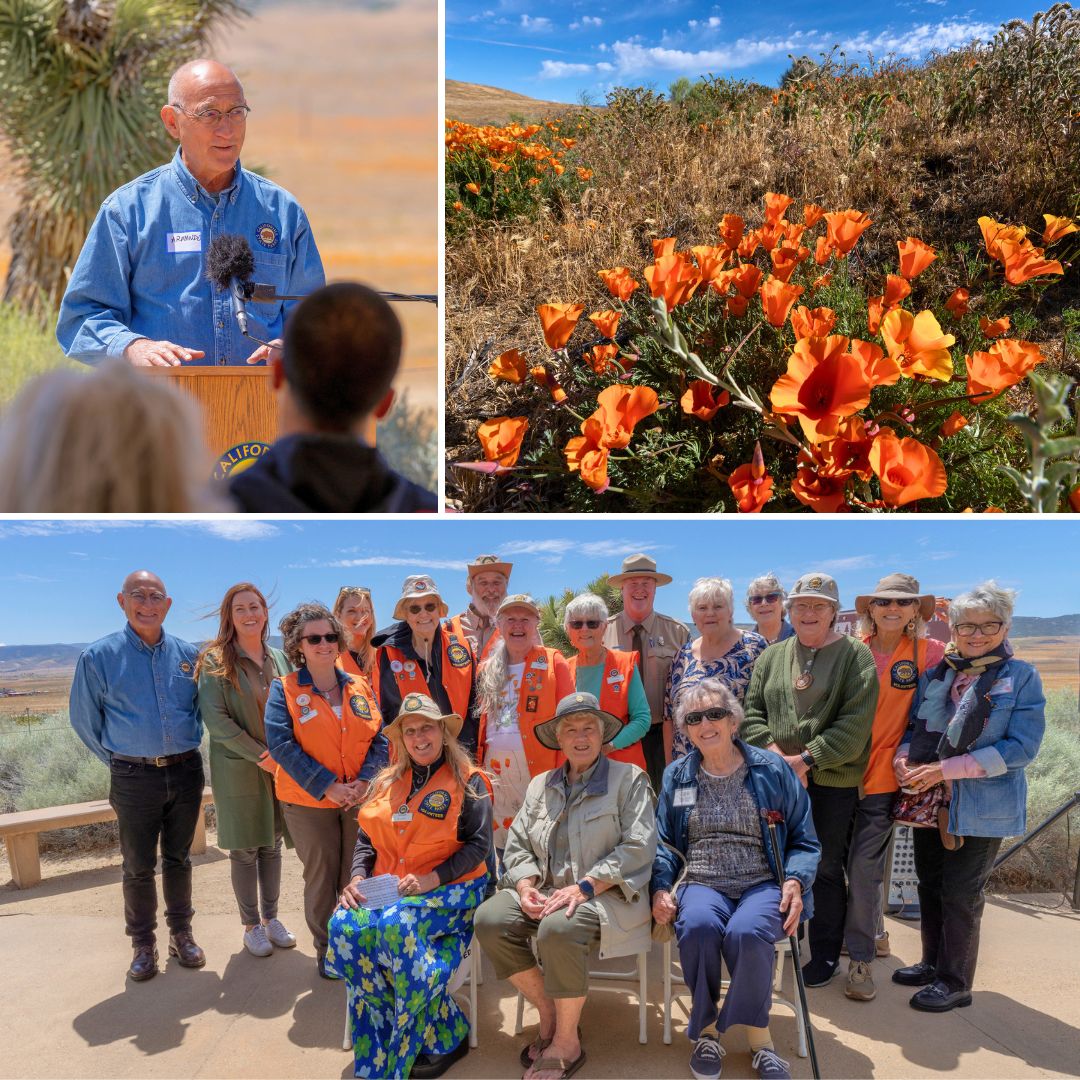 Clockwise from top left: California State Parks Director Armando Quintero speaks at the Antelope Valley California Poppy Reserve’s 50th anniversary celebration. California poppies at the reserve this year. Attending Poppy Reserve Mojave Desert Interpretive Association board members and Poppy Reserve volunteers pose with California State Parks leaders.
LANCASTER — Antelope Valley California Poppy Reserve State Natural Reserve (Poppy Reserve) on Friday, April 24, marked the 50th anniversary of its dedication, celebrating five decades of protecting and preserving California’s native wildflowers – including the state’s official flower, the California poppy. In collaboration with the Poppy Reserve Mojave Desert Interpretive Association (PRMDIA) and the California State Parks Foundation, California State Parks proudly commemorated the milestone with a special ceremony honoring the people, partnerships, and community efforts that helped establish and sustain the 1,800-acre reserve in the Antelope Buttes west of Lancaster.
“As we celebrate 50 years of this remarkable state natural reserve, we also honor the people whose vision and dedication have helped preserve this treasure for future generations,” said California State Parks Director Armando Quintero. “While this anniversary is a powerful reminder of what can happen when communities come together to care for the places they cherish, we acknowledge the tribal people of the Shoshonean, Tataviam and Tongva Bands who have lived on and cared for these lands since time immemorial.”
“California State Parks Foundation purchased 940 acres of wildflower land and deeded it to California State Parks in the 1970s. That land became California’s first ‘Poppy Park’ and would eventually be known as the Antelope Valley California Poppy Reserve State Natural Reserve,” said California State Parks Foundation Executive Director Rachel Norton. “Thanks to this park, so many Californians have experienced firsthand the incredible beauty of the state’s official flower. We celebrate the park’s 50th anniversary and all who made the preservation of this place possible.”
“Our state park cooperating association, the non-profit Poppy Reserve Mojave Desert Interpretive Association, stands on the shoulders of giants,” said PRMDIA President Margaret Rhyne. “These giants include citizens of the Antelope Valley: Milt Stark, Jane Pinheiro, Dorothy Bolt, and many others. Without their ingenuity and determination, the Antelope Valley California Poppy Reserve would not exist. Organizations joined these giants to create a park for poppies, led by the Lancaster Women’s Club and the California State Park Foundation. We owe these visionary leaders our eternal gratitude.”
The celebration took place in the courtyard of the Jane S. Pinheiro Interpretive Center, overlooking the reserve’s rolling hills. It brought together tribal leaders and members from the Fernandeño Tataviam Band of Mission Indians, Yuhaaviatam of San Manuel Nation, Kitanemuk and Yowlumne Tejon Indians, and Morongo Band of Mission Indians, along with local and elected officials, community partners, and descendants of families whose land helped form the reserve. Attendees reflected on the park’s legacy, explored exhibits, and walked nearby trails to take in wildflower displays.
“Thanks to the tireless efforts of the Lancaster Woman’s Club, the Wildflower Preservation Committee, California State Parks Foundation, and visionary leaders like Jane S. Pinheiro, we proudly celebrate the 50th Anniversary of the California State Poppy Reserve,” said Rep. George Whitesides (D-CA). “This remarkable milestone stands as a testament to the power of community and serves as a reminder of what can be accomplished when people come together in service of preserving our natural heritage for future generations. I am so proud to advocate for this region and our incredible traditions in Congress.”
“For fifty years, the poppy has been a bright, cheerful reminder that even the simplest things can carry meaning and bring people together,” said Assemblyman Tom Lackey (R-Palmdale). “As we celebrate this anniversary, it’s a chance to appreciate the poppy not just for what it represents, but for the little moments of joy and connection it continues to inspire.”
Over the past five decades, the Poppy Reserve has expanded in size and undergone many improvements, including accessible trails and new exhibits and features that ensure more people of all abilities can enjoy the park in more ways. Today, it welcomes tens of thousands of visitors each year – sometimes exceeding 200,000 during peak bloom seasons – drawn by its colorful displays of wildflowers, including California poppies.
How it started:
The Poppy Reserve was born from a grassroots effort to protect California’s wildflower heritage. In the 1940s, local resident Jane S. Pinheiro, a self-taught artist, recognized the threat posed by rapid development to local wildflower fields. Determined to protect the California Poppy, the state's official flower, she dreamed of creating a "Poppy Park." Jane collaborated with the Wildflower Preservation Committee, along with the Lancaster Woman's Club and the California State Parks Foundation, to raise funds to purchase land for a park. Schoolchildren across California contributed by collecting "Pennies for Poppies." Their combined efforts led to the successful establishment of the Antelope Valley CaliforniaPoppy SNR, which officially opened in 1976.
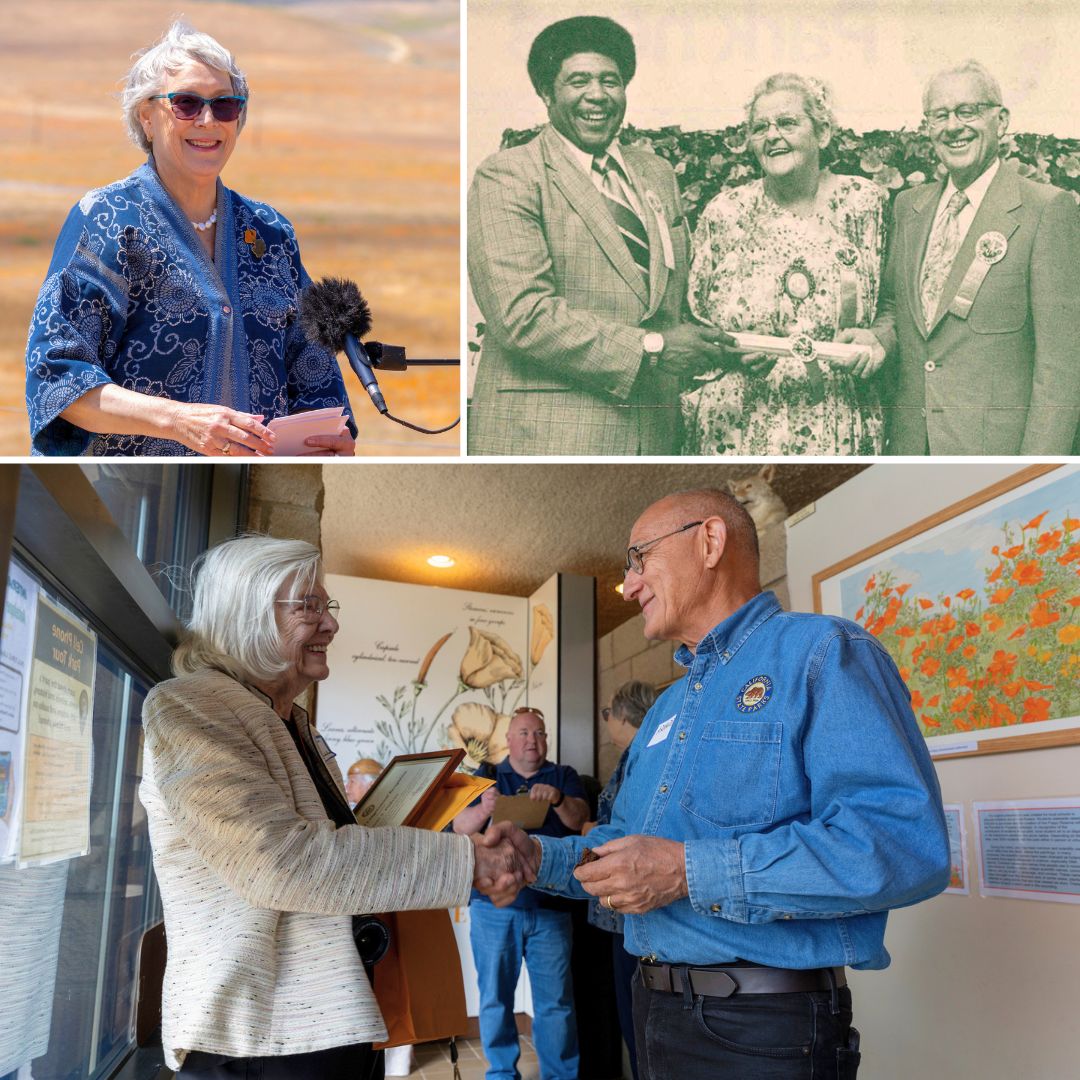 Clockwise from top left: PRMDIA President Margaret Rhyne speaks about the history of the Poppy Reserve. Jane Pinheiro at the dedication of the park in 1976 with then-California State Parks Director Herbert Rhodes and then California State Parks Foundation President William Penn Mott, Jr. California State Parks Director Quintero greets Mary Wilson of the Wildflower Preservation Foundation inside the Jane S. Pinheiro Interpretive Center.
Milestones:
- 1976: Officially designated as Antelope Valley California Poppy Reserve SNR
- 1977–1981: Expanded by 339 acres through state land acquisitions.
- 1982: Jane S. Pinheiro Interpretive Center completed.
- 1995: Interpretive center renovated with new exhibits and features.
- 2016: A 0.7-mile accessible walking trail is added.
How it’s going:
Visitors to the park can experience the beauty of this reserve and explore eight miles of trails that wind through rolling hills and seasonal wildflower displays, including a paved, wheelchair-accessible path. The Jane S. Pinheiro Interpretive Center includes exhibits on local flora and fauna and a gallery of Pinheiro’s botanical artwork. The center is open March 1 through Mother’s Day from 10 a.m. to 4 p.m. weekdays and 9 a.m. to 5 p.m. on weekends, with an orientation video and a gift shop operated by the non-profit Poppy Reserve Mojave Desert Interpretive Association. As California State Parks celebrates this 50-year milestone, the department invites the public to experience the reserve and help protect it for generations to come.
For more information, visit parks.ca.gov/PoppyReserve.
Subscribe to California State Parks News via e-mail at NewsRoom@parks.ca.gov
California State Parks provides for the health, inspiration and education of the people of California by helping to preserve the state’s extraordinary biological diversity, protecting its most valued natural and cultural resources, and creating opportunities for high quality outdoor recreation.